
Deciphering Linear A, one checkable line at a time
Oliver Woods and Spencer Jemelka, 1,721 inscriptions, and one aim: decipher Linear A carefully.
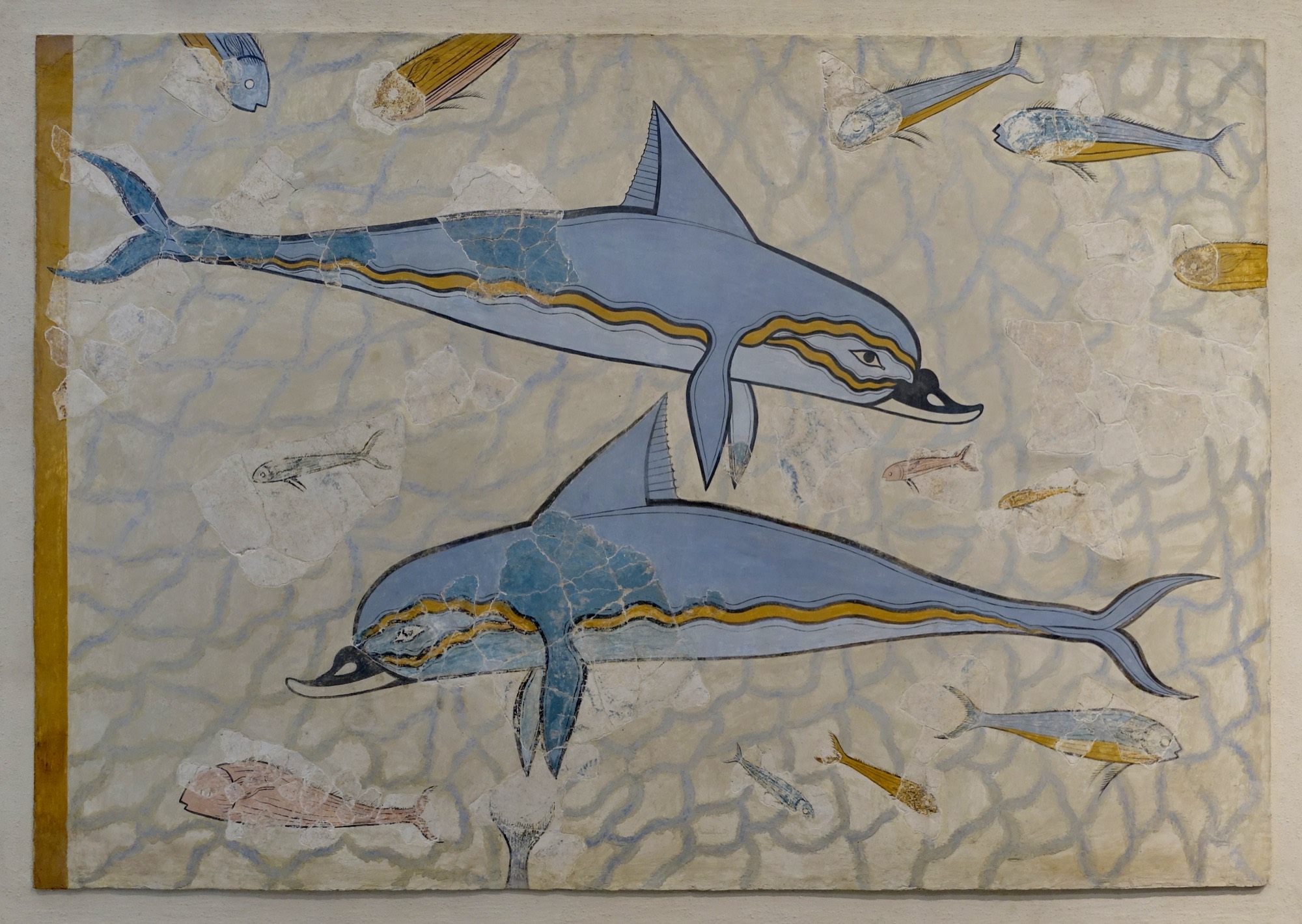
The Dolphin Fresco · Palace of Knossos · Heraklion Archaeological Museum
Photograph:
Olaf Tausch / Wikimedia Commons
· CC BY 3.0

Can AI decipher Linear A? Not yet. Linear A remains undeciphered. This human-led project uses AI tools alongside scholarship and strict checks against the tablets. This release reports the results that currently survive checking: account structure, arithmetic anchors, name candidates, and evidence about corpus quality.
In brief
The project. Oliver Woods and Spencer Jemelka are using Claude Code, ChatGPT, and Codex as research assistants for a long-running attempt to read Linear A. The tools help with search, collation, code, comparison, and objection generation. The authors set the claims, check the sources, and write the final interpretation.
The problem. Linear A writes an unknown language of Bronze Age Crete. Many signs have conventional sound values because they resemble Linear B signs, but the grammar, vocabulary, and language family remain unresolved.
The present claim. Some account structure can now be tested with unusual clarity. Totals, deficits, quantities, name-like entries, and data problems can be studied directly, while ordinary sentences and most vocabulary remain open.
The method
The method starts with Kober and Ventris. We first ask where a sign or word appears, what kind of document it appears in, what numbers are near it, and whether the same pattern repeats elsewhere. We then check the pattern against the printed editions and against tests written before the result is known. Claims are retired or demoted when plate checks, null tests, or corpus controls fail.
Structure before meaning
Alice Kober showed that pattern, position, and endings have to be described before anyone guesses a translation.
Grids and checks
Michael Ventris solved Linear B by testing sign values against repeated patterns until the grid began to explain real records.
Tablets first
The printed editions and photographs stay in charge, because a reading cannot stand if the tablet does not support it.
Controls
Failure tests
For important claims, we write down what would count as failure before we run the test, then retire or demote claims that fail.
An account that checks itself
Tablet HT 88 from Haghia Triada is useful for decipherment because the account checks its own total. It lists six people, each with one unit, and the scribe closes the account with KU-RO followed by the numeral 6. Hover over any sign to see its reading and its evidence tier, then run the check to watch the entries add up to the total the scribe recorded.

What we have found so far
The findings are modest, but they matter. Most of the strongest readings build on earlier scholarship; our contribution is to test them across the corpus, keep the failures visible, and separate strong evidence from weaker candidates. Some account words and account roles can be tested because the tablets contain their own totals. Some name-like entries can be studied from list structure. Some links with later Linear B records can be checked against controls. The same process also finds failed ideas and problems in the data.
◆ Tier A proven by the tablets' own numbers ● Tier B strong evidence, checked against controls ▲ Negative a result that came back empty, reported anyway
Accounting anchors with different levels of confidence
Some tablets add up their own figures. That makes KU-RO a strong bounded anchor for “total”, and PO-TO-KU-RO a strong bounded anchor for “grand total”. A list of six people, each marked as one, ends with KU-RO and the figure 6. Another tablet has subtotals of 31 and 65, plus one carried unit, and closes with PO-TO-KU-RO and the figure 97. KI-RO is also an important account-role reading, but it needs tighter distributional checks than the total words. Earlier scholars proposed these readings; this project tests how far the arithmetic can support them.
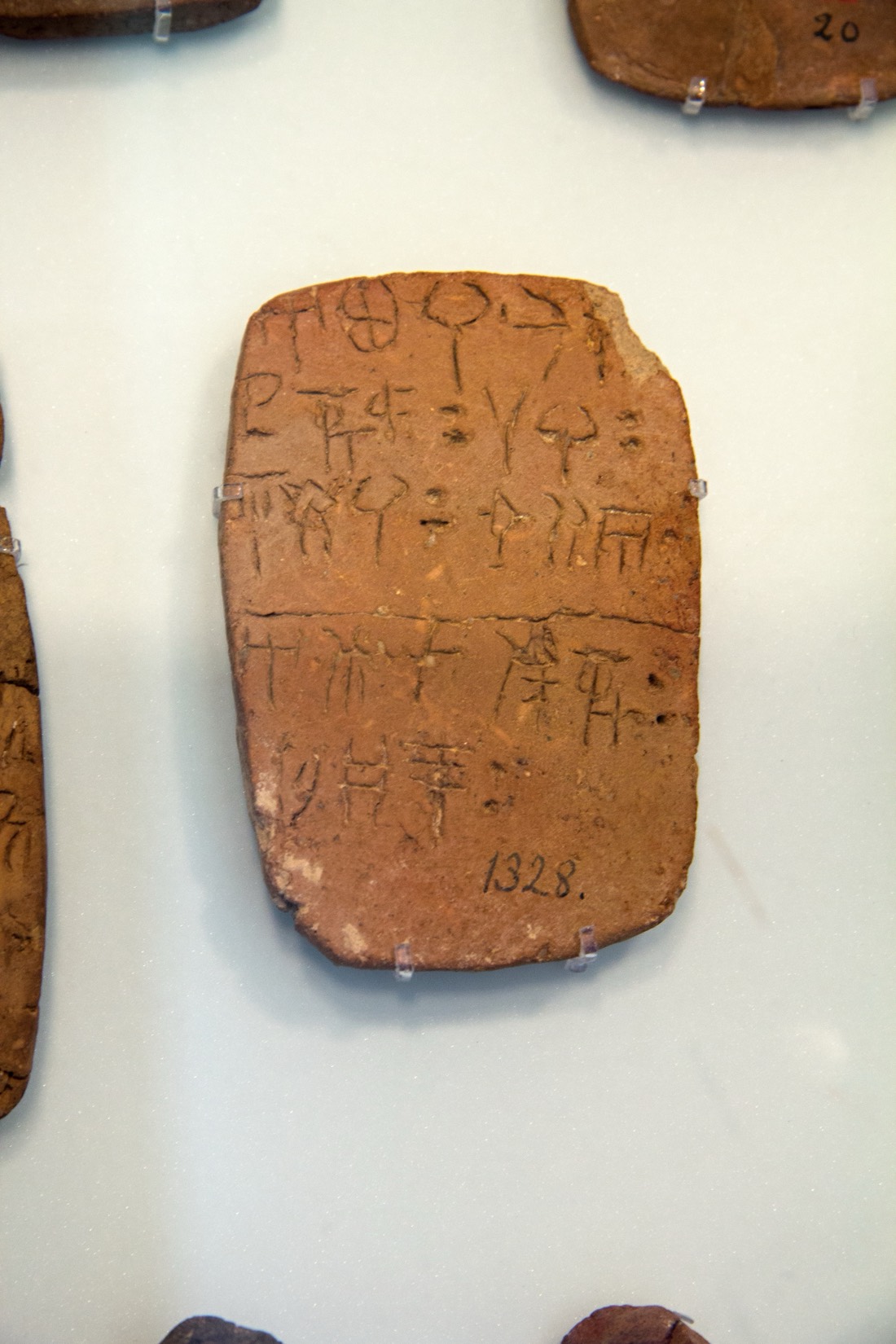
Late Minoan IB · c. 15th century BCE
Clay, impressed with a stylus
Heraklion Archaeological Museum This is working clay rather than painted plaster. It carries rows of personal names, a ruled line, and an entry that closes the account, and the arithmetic shown on the left lives on objects exactly like this one. Photograph: Zde / Wikimedia Commons · CC BY-SA 4.0

We can identify some name-like entries in lists
Names often survive a change of writing system without being translated, so they are a useful starting point. We built a method that looks for name-like entries from list structure, without assuming a language. As a validation check, we tested it against names that scholars had already connected with later records. It found 10 of 17. This tests whether our detector can recover names at all. It is separate from the cross-script name matches shown below, which ask whether specific Linear A names continue into Linear B.
Some names may continue across the two scripts
After Greek-speaking administrators began using Linear B on Crete, some names in the Knossos As-series rosters still resemble Linear A name candidates. In our current comparison set, five As-series roster names resemble Linear A name candidates more often than the comparison group does. This is a promising signal, but it depends on the present normalization, comparison set, and source-history review. The five candidate names are I-TA-JA, A-TI-RU, I-DA-MI, ME-KI-DI, and KU-NI-TE. Earlier scholars have proposed I-TA-JA, which we re-check here. For A-TI-RU, I-DA-MI, ME-KI-DI, and KU-NI-TE, we have not yet identified prior published proposals in our current literature check. We therefore describe them as potentially new candidate correspondences, not established discoveries, pending fuller source-history review and independent scrutiny. This is an onomastic continuity signal. It is evidence about names, not a reconstruction of population history.
Name-like roster entries are enriched in a bounded test set
A large part of the corpus is made up of words that appear only once. Some of these may be personal names rather than ordinary vocabulary. In the bounded roster tests, name-like entries are enriched enough to deserve serious follow-up. The exact scope and strength of this result still need reconciliation across the full corpus.
We reviewed a widely used digital transcription
Many computational studies of Linear A start from a shared digital transcription, so transcriptional or editorial decisions can propagate into later analyses. We compared the working digital text against an independent expert sign record and flagged a material number of word-level readings as different, uncertain, or requiring review. Some cases involve damaged signs being joined or regularized in ways that make the text look more complete than the underlying evidence allows. Where published photographs or reproductions were available and legible, we checked the relevant readings against them; remaining cases stay source-pending. This matters because any decipherment attempt depends on the quality of the text it is trying to read.
We test our own best ideas, and report it when they fail
Later Cypriot writing belongs to the wider Aegean script tradition, so we tested whether any candidate Linear A names also appeared in the Cypriot material. We compared 28 names from Cyprus against the Minoan name pattern and found no match. We hold our own ideas to the same standard. One broad account theory was rejected after a test we had written down before running it. The failures stay in the record because they help define what the evidence can and cannot support.
Current position
What we can support now
- Ledger structure and totals in selected account contexts.
- Strong arithmetic anchors for KU-RO and PO-TO-KU-RO, with KI-RO treated as a scoped account-role reading.
- Name-like roster entries, including a small candidate Linear A / Linear B onomastic-continuity signal; some correspondences may be previously unrecognized, but remain under source-history review.
- Data-quality findings that affect how damaged words, lacunae, and digital corpus entries should be used.
What remains unresolved
- The language as a whole remains unresolved.
- Ordinary sentences, most vocabulary, religious formulas, and fluent translation remain unresolved.
- No new phonetic values, deity readings, cognates, or language-family identification are established here.
- Working out the language behind Linear A remains the heart of the mission.